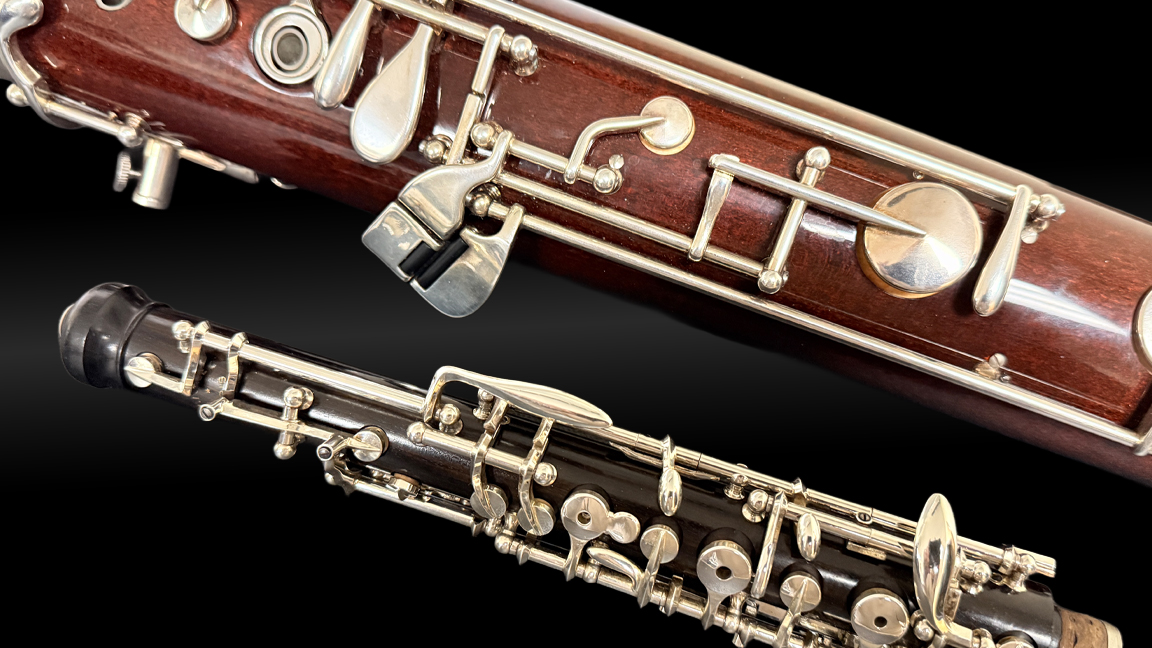

Choosing a bassoon is a more nuanced process than many expect. With a wide range of instruments available—spanning student models to highly refined professional systems—it can be difficult to determine what truly matters, and how to recognize an instrument that will support your playing.
After decades of working with bassoons as a repair specialist, dealer, and musician, I’ve found that the right choice becomes much clearer when you focus on how an instrument responds, how it feels under the hands, and how consistently it performs across the range. This guide is designed to help you approach that process with confidence and clarity.
Who This Guide Is For
This guide is intended for:
Advancing students preparing for a more capable instrument
Adult players returning to the bassoon
Serious musicians considering an upgrade
Parents helping a student move beyond a basic model
If you’re looking to better understand what separates one instrument from another—and how to choose wisely—this guide will give you a solid foundation.
What Actually Matters in a Bassoon
While specifications and brand names are often emphasized, the most important qualities of a bassoon are experienced through playing.
Tone
A good bassoon produces a tone that is rich, stable, and well-supported throughout the range. The sound should feel grounded in the low register while remaining clear and singing in the tenor range.
Response
Response refers to how easily the instrument speaks. A well-functioning bassoon should allow notes to begin cleanly and predictably, without excessive effort. This is especially important in softer dynamics and in technical passages.
Intonation
Consistency of pitch across registers is critical. A well-designed instrument allows for manageable adjustments without forcing the player into uncomfortable embouchure or air compromises.
Evenness Across Registers
The bassoon spans a wide range, and transitions between registers should feel smooth and predictable. No single register should feel dramatically weaker or more resistant than the others.
Build Quality
Materials, craftsmanship, and mechanical precision all contribute to the instrument’s reliability and longevity. A well-built bassoon will not only sound better, but will remain stable over time.
What to Listen for When Trying a Bassoon
When testing a bassoon, it’s important to play across the full range and listen carefully to how the instrument responds in different situations.
Start in the low register. The sound should be full and stable, without excessive spread or instability. Notes should speak without delay and maintain a consistent core.
In the tenor register, listen for clarity and ease of projection. This is where much of the bassoon’s expressive character lives. The instrument should allow for a singing tone without feeling tight or forced.
As you move higher, notice whether the instrument remains cooperative. The upper register should feel accessible, not resistant, and should maintain both tonal integrity and pitch stability.
Pay close attention to articulation. Notes should begin cleanly without needing excessive effort or adjustment. A responsive instrument will feel predictable and reliable in both slow and technical passages.
Finally, notice how the instrument settles under your control. A good bassoon gives a sense of cooperation—it responds to your input rather than requiring constant correction.
Understanding Instrument Levels
Bassoons vary significantly across student, intermediate, and professional levels, and understanding these differences is key to making a good decision.
Student Instruments
Built for durability and accessibility, student bassoons are designed to be manageable for developing players. They are typically more limited in tonal complexity and flexibility.
Intermediate Instruments
Intermediate bassoons offer improved response, more refined tone, and greater consistency. For many players, this level represents a meaningful step forward in both comfort and musical capability.
Professional Instruments
Professional bassoons provide the highest level of tonal depth, projection, and flexibility. They require a more developed technique but offer significantly greater expressive potential.
Moving too quickly into a professional instrument can sometimes be counterproductive. A well-matched intermediate instrument often provides a more supportive and productive playing experience during key developmental stages.
When Is It Time to Upgrade?
You may be ready to move to a different instrument if:
Your current bassoon feels resistant or inconsistent
You’re working harder than necessary to produce a stable tone
Intonation is difficult to manage despite solid fundamentals
The instrument limits your ability to shape phrases or dynamics
An appropriate upgrade should feel like an expansion of your capabilities, not an added challenge.
Common Mistakes to Avoid
Choosing Based on Price Alone
While budget is important, the least expensive option is not always the best value if it limits progress.
Advancing Too Quickly
A professional instrument may not respond well to developing technique and can make playing more difficult rather than easier.
Ignoring Condition
Two instruments of the same model can perform very differently depending on maintenance and setup.
Overlooking Ergonomics
Key placement and overall feel matter. An instrument should feel comfortable and natural under the hands.
The Importance of Proper Setup
Even an excellent bassoon will underperform if it has not been properly adjusted. Small mechanical issues—such as minor leaks, pad wear, or regulation inconsistencies—can significantly affect response, tone, and intonation.
It is not uncommon for a player to struggle with an instrument that is fundamentally sound but simply not functioning at its best. In these cases, the issue is often not the design of the instrument, but its setup.
A thorough inspection and professional adjustment ensure that the instrument is sealing correctly, responding evenly, and operating as intended. This allows you to evaluate its true qualities without interference from avoidable mechanical issues.
For this reason, the preparation and condition of a bassoon are just as important as the model itself. An instrument that has been carefully serviced and play-tested will provide a far more reliable and rewarding experience.
New vs. Pre-Owned Bassoons
Both new and pre-owned instruments can be excellent choices, depending on the individual instrument and how it has been prepared.
New Instruments
Consistent condition
Manufacturer support
Higher initial cost
Pre-Owned Instruments
Often offer strong value
May already be “played in”
Require careful evaluation and proper setup
A well-maintained and properly prepared pre-owned bassoon can be an outstanding option, often providing a high level of performance at a more accessible price.
A Note on Makers and Systems
Bassoons are built in different systems and styles, with German (Heckel-system) instruments being the most widely used. Within that system, there are many respected makers, each with their own approach to tone, scale, and response.
Rather than focusing solely on brand, it is more useful to evaluate how a specific instrument performs. Even within the same maker, individual instruments can vary significantly.
Final Thoughts
The right bassoon is one that supports your playing and allows you to develop with confidence. It should feel stable, responsive, and consistent across the range, giving you the freedom to focus on making music.
Taking the time to evaluate instruments carefully—and to understand what you are hearing and feeling—will lead to a far better outcome.
If You’d Like Guidance
If you would like assistance evaluating a bassoon, discussing options, or arranging a trial, we are always happy to help. Choosing the right instrument is an important step, and it’s one we approach with care and attention.