
Along with any additional work required to restore proper function, response, and overall playing condition.
All removable metal work is fully disassembled, degreased, hand cleaned, reoiled, and hand buffed. All posts and attached metal work are degreased, hand cleaned, reoiled, and hand buffed. All cork and leather pads are replaced.
All tenon corks, key corks, springs, and bumper felts are replaced. The exterior of the body is hand cleaned, oiled, and polished. The interior bore is hand cleaned oiled with a possible combination of sweet almond oil, walnut oil, vitamin E oil, and/or other oils as appropriate, and polished. Light repair of body and finish defects is included. All of the tone holes are examined and cleaned. Any tuning material in the tone holes is replaced if it’s failing.
Light repair of the tone holes is included if needed. The instrument is reassembled and fully mechanically adjusted for smooth operation, balanced feel, and correct response. Intonation and tone anomalies are resolved as possible. The instrument is extensively play tested. Basic case cleaning is included.
If additional issues are discovered during the overhaul, we will explain them clearly, discuss the options with you, and proceed only with your approval.
Typical full overhaul costs vary depending on the instrument and its condition:
Student instruments: typically $800
Intermediate instruments: $800 – $1,200+
Professional instruments: $1,200 – $1,800+
Final pricing is confirmed after inspection and before work begins.
Each instrument is carefully evaluated, with consideration given to both its current condition and the goals for its future use. From there, the structural and mechanical work is defined to return the instrument to excellent, reliable playing condition while preserving its original character.
Cost and timeline depend on the instrument’s condition and the extent of the work required.
If your instrument requires prompt repair, please call the shop during business hours.
If we are assisting another client or away from the bench, please leave a message and we will return your call as soon as possible.
Many issues can be repaired the same day. All work is performed on site by Brian Charles, and in many cases the repair can be completed while you wait. Costs depend on the nature of the problem, and all options will be explained before any work begins.
Prevent costly problems and performance issues by having your oboe or bassoon cleaned, oiled, and adjusted each year.
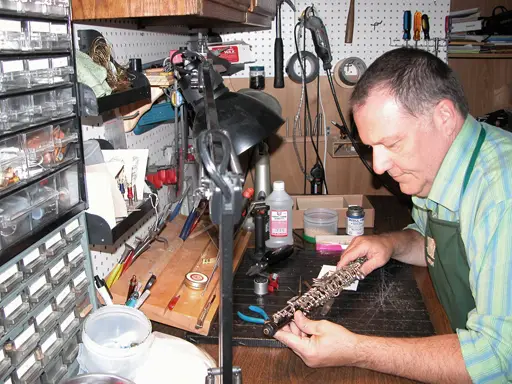
Brian Charles is the founder and owner of Charles Double Reed Company. A double reed player since the seventh grade, Brian began his professional work in the 1980s as reed maker at Ponte Music Company in New York City while studying performance at the Manhattan School of Music and The Juilliard School.
During this time he worked with noted repair technicians Saul Fromkin and Pedro Rivera, experiences that sparked a lasting interest in the craft of double reed repair and restoration. Over the years Brian has developed a national reputation for his work with oboes and bassoons, serving members of major orchestras, professional doublers, teachers, and students throughout the United States.
In addition to his repair work, Brian regularly presents workshops across the country on double reed repair and reedmaking. He has been the in-house repair technician for the Puerto Double Reed Festival for the past 4 years.
Brian is an accomplished performer and composer. While best known for his work on oboe and bassoon, he also performs on flute, clarinet, saxophone, and didgeridoo, often incorporating electronics in combination with his acoustic instruments.
He was commissioned by Yamaha Corporation to compose and perform works for the Yamaha MIDI Grand Piano when the instrument was first introduced among other composing opportunities.
His playing career has included Broadway productions, commercial recordings, symphonic tours, and a wide range of solo and collaborative projects.